Category: Appalachian heritage

  • The Melungeons: Conversos, Crypto-Jews and Hidden Jews in Southern Appalachia – Part 4 , Rediscovering Jewish Origins

    The Melungeons: Conversos, Crypto-Jews and Hidden Jews in Southern Appalachia – Part 4 , Rediscovering Jewish Origins

    Modern-day Melungeons who are rediscovering their Jewish ancestry are faced with asking:

    • For how many generations was my family aware of their heritage?
    • How was this information transmitted and by whom?
    • Is it anywhere written down, preserved or recorded?
    • Who else knew about us, and what did they know?
    • When and how were decisions made to bury this information?
    • Is it even possible for a family to have held onto vestiges of this heritage and passed them down for 500 years?

    The answer to that last question is yes.  For her book Suddenly Jewish: Jews Raised as Gentiles Discover Their Jewish Roots, Barbara Kessel interviewed descendants of Spanish settlers of the American Southwest. 


    Many of the original Europeans in the Southwest were Crypto-Jews who lived outwardly as Catholics but secretly as Jews, and their descendants are just now learning about their true heritage.  Many are converting to Judaism. Kessel quoted one interviewee as saying, “…five hundred years and now I find myself home…You can be away five hundred years and then come home… Nobody said Kaddish (the Jewish Mourners’ Prayer) for this family for five hundred years.  This will be my project.” 

    If families in the Southwest can hold onto and pass down, even in small ways, information about their heritage, it certainly can also be true of Melungeon families in Appalachia.

    Also from Kessel’s book, “Parents who deny their Jewishness inevitably send out signals.  They leave clues that their children pick up on, though neither side – parent or child- may be consciously aware of what is happening.” 

    Kessel quotes Canadian psychiatrist Robert Krell, “I think it’s hard for parents not to, from time to time, give a hint.  There may be a thousand slips of the tongue which the child does not connect to being Jewish.  Yet there is a subtle awareness.  The question becomes: when does the observation get crystallized by the child into the construct,’Perhaps I am a Jew?’”


    My Family’s Journey

    I often wonder when in my family the decision was made to hide our Jewish heritage. I now know that I am Melungeon and Sephardic (Jewish from the Iberian peninsula, that is, Spain and Portugal) on both sides of my family and also Askenazic (Jewish from Eastern Europe) on my father’s side.

    Both my mother and my father knew they were Jewish but hid that fact and lived as Christians. My grandparents were nominal Christians, as were some of my great grandparents. Whatever led my family to decide to hide their heritage, that decision was certainly cemented in the early 1900s.

    One of my great grandfathers, an attorney and newspaper editor and publisher, was serving in the Georgia State Legislature in 1913-1914 during the time of the arrest and trial of Jewish businessman Leo Frank. My great grandfather was described in Atlanta newspaper reports as being “broad and liberal in his views,” and he was noted for voting for progressive legislation. He would have been well-known by other newspaper editors and prominent politicians of his day.


    My great grandfather, Travis Glenn Dorough


    Leo Frank, who was the Jewish superintendent of a factory in Atlanta, was found guilty of murder and sentenced to death in August, 1913. In 1915, the governor of Georgia commuted Frank’s sentence to life in prison. By that time anti-Semitism was rampant in Georgia, a former governor was calling for the people to form mobs, and my great grandfather was no longer serving in state government. On August 17, 1915, a lynch mob literally attacked the state prison where Frank was being held, transported him 150 miles, and hanged him.

    (Evidence later uncovered, although not conclusive, pointed to another man as the murderer, and in 1986, Frank finally was granted a posthumous pardon.)
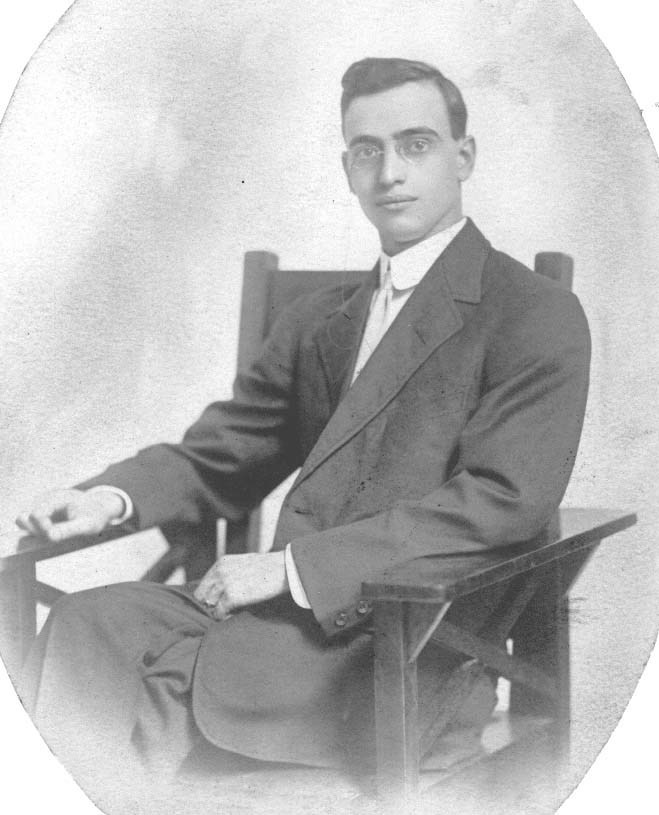

    Leo Frank (Photo credit: https://thebreman.org/research/leo-frank/)


    In the aftermath of the lynching, lawyer, newspaper editor and politician Tom Watson called for a revival of the Ku Klux Klan in Georgia and throughout the South. The Klan sought a charter from the Georgia Secretary of State and was officially revived in November of 1915.

    By 1920, Tom Watson was serving in the U.S. Senate and declaring himself to be “King of the Ku Klux.” Klan chapters were being organized throughout the South, and Klan marches were being held in major cities. Watson, now an open racist and member of the Klan, had once been seen as the progressive leader of the Populist Party in Georgia, the party of which my great grandfather had been a member.


    Tom Watson (Photo credit: https://www.georgiaencyclopedia.org/articles/history-archaeology/thomas-e-watson-1856-1922/)


    I don’t know if my great grandfather was Jewish, but my great grandmother had Melungeon and Jewish ancestry, and it was in 1920, in the midst of KKK threats and marches that my great grandparents loaded up their 6 daughters in a wagon and fled in the night to another county in North Georgia where they felt they would be safer. One of those daughters, Annie, was Black and had been taken into the family as a child. My grandmother told me that Annie was raised as their sister.

    My father’s family was in North Carolina and would have faced similar threats. My father’s grandmother always insisted they were “Black Dutch,” and warned my father against ever researching his ancestry.

    Thus, families that had not already hidden their Jewish ancestry certainly began to hide it in the 1920s.

  • The Melungeons: Conversos, Crypto-Jews and Hidden Jews in Southern Appalachia – Part 1

    The Melungeons: Conversos, Crypto-Jews and Hidden Jews in Southern Appalachia – Part 1

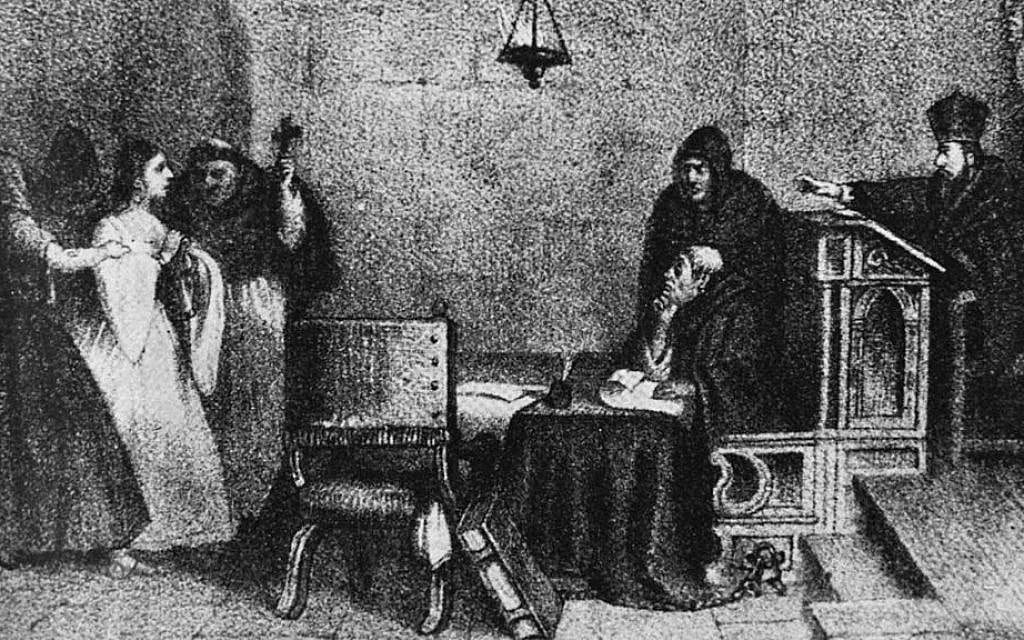
    Conversos- Jews from Spain and Portugal who, to escape torture and death, converted to Christianity during the Spanish Inquisition of the 14th and 15th centuries; also refers to their descendants

    Crypto-Jews – Those who outwardly converted but maintained Jewish traditions in secret


    The Inquisitor’s tribunal


    Melungeons

    When the English and Scots-Irish first began to explore and settle the Southern Appalachians, they reported encountering a strange people with distinctly European features but darker skinned than Northern Europeans, speaking strange languages, and claiming to be Portuguese and sometimes Jewish.

    These mysterious people, known as Melungeons, may have settled the Appalachian wilderness as early as 1567, forty years before the Jamestown settlement and over 150 years before the English and Scots-Irish began to move into some of these areas.

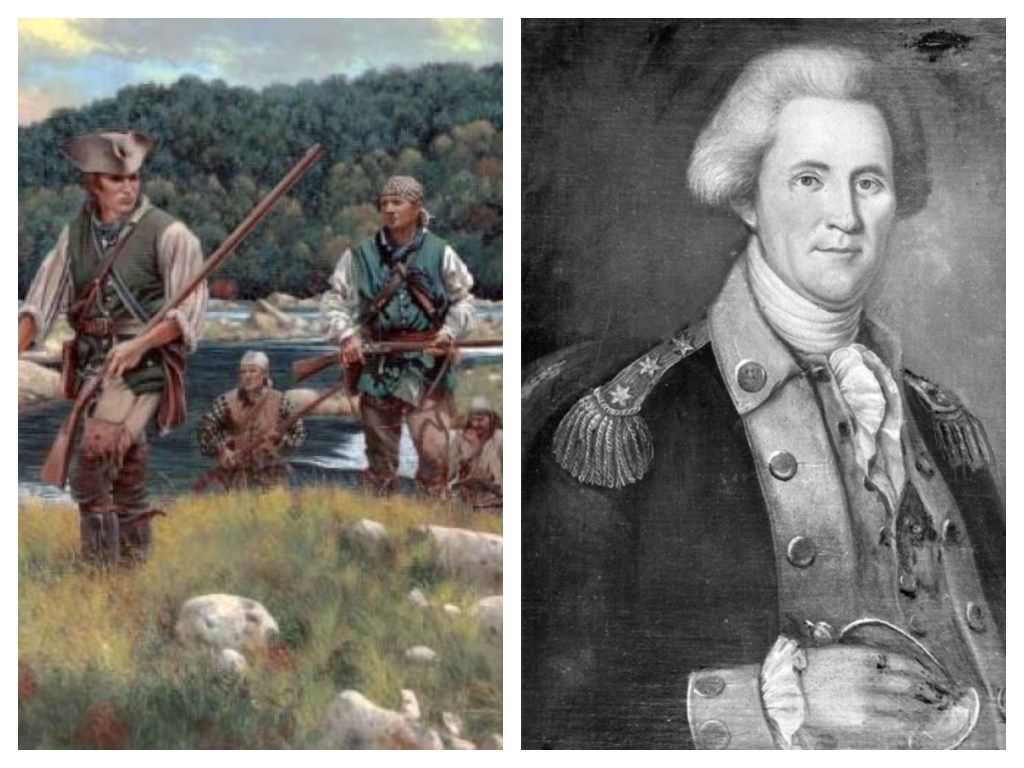
    No one knows exactly when the English and Scots-Irish settlers first “discovered” the Melungeons, although Melungeon numbers were substantial by the time John Sevier, who later became Governor of Tennessee, encountered them in 1784.  


    There are accounts of Melungeons in the Alleghanies in 1654 and also in the Carolinas as early as the mid-1600s. By the 1750s, they were speaking a broken form of English and had English or Scottish surnames, but were claiming a Mediterranean heritage, usually Portuguese but also Spanish.

    Also unknown is the origin of the term Melungeon. It has been suggested that the word comes from an Arabic word meaning “cursed souls” or from the French word “mélange” for mixed race. Melungeons were described as being a dark skinned, reddish brown-complexioned people with fine European features, dark eyes, and dark hair. They spoke strange languages and did not fit completely into any of the traditional racial categories that existed at the time: white, black, mulatto or Indian. When the first U.S. census was taken in 1790, many Melungeons were designated as FPC, Free Persons of Color. In subsequent years, many Melungeon families attempted to avoid the census takers altogether.


    By the 1800s, Melungeons in many areas had intermarried with incoming European settlers, runaway slaves and surrounding Native American tribes to the extent that families “became” Indian or black or white. Those with fairer skin were able to hold onto their bottomlands in Appalachia and prospered. Others retreated higher into the mountains.

    Many Melungeons lost their roots and the knowledge of their ancestry and heritage, but in the past few decades many Melungeon descendants have rediscovered and embraced that ancestry.

    Modern DNA studies have shown that Melungeon descendants are a tri-racial group with European, Native American, and African ancestry. When first encountered, they claimed to be of Mediterranean descent, specifically Portuguese, and today, many Appalachian people of Melungeon descent are finding that they do have Jewish ancestry from the Iberian Peninsula (Spain and Portugal).

  • Defining Appalachia

    Defining Appalachia

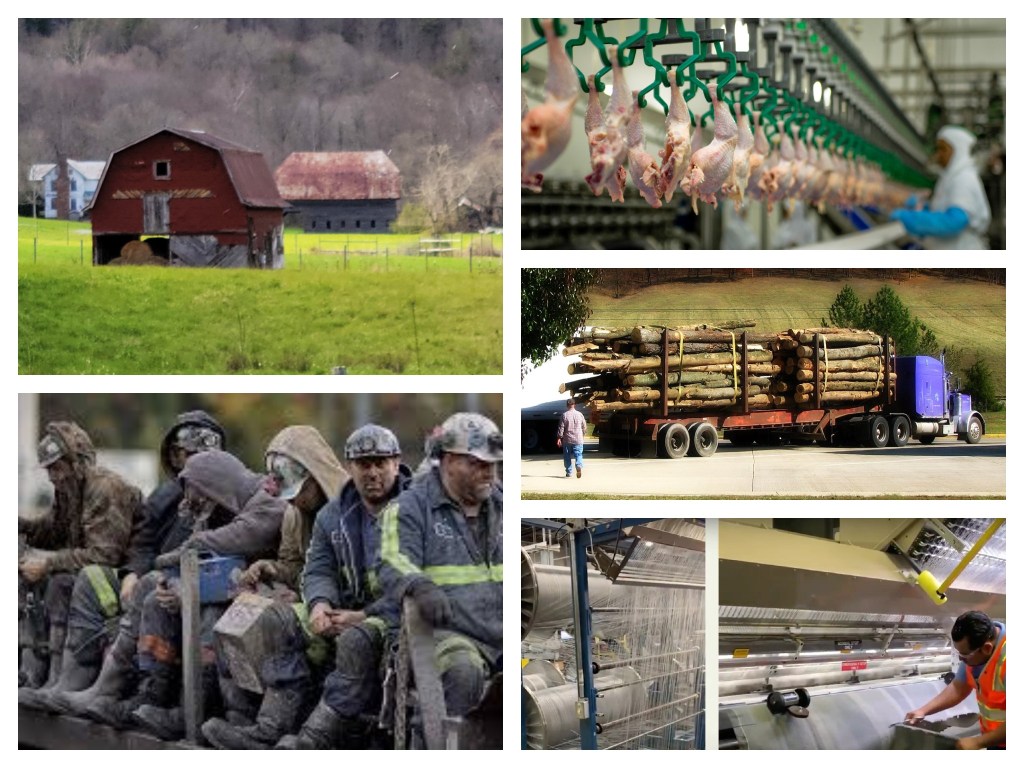
    For people not from Appalachia, the very word Appalachia conjures up images of poverty and backward, uneducated people who speak strangely and make a hardscrabble living farming or working in poultry plants, textile mills, logging, or coal mining.


    But it is and always has been much more than that.

    I grew up in Appalachia, spending my childhood here with grandparents who were born in the early 1900s and a great grandmother who was born in 1880. I grew up in a small town in a prosperous, educated family, but the old stories, music, and folkways were passed down to me. As a young adult I moved away but returned thirty years ago as my daughter was entering high school, and since then I have lived even further into the hills than when I was a child.

    Back in 2012, when I began blogging, the first post I ever published was Why I Live in the Woods, which explains the reasons I love it here.

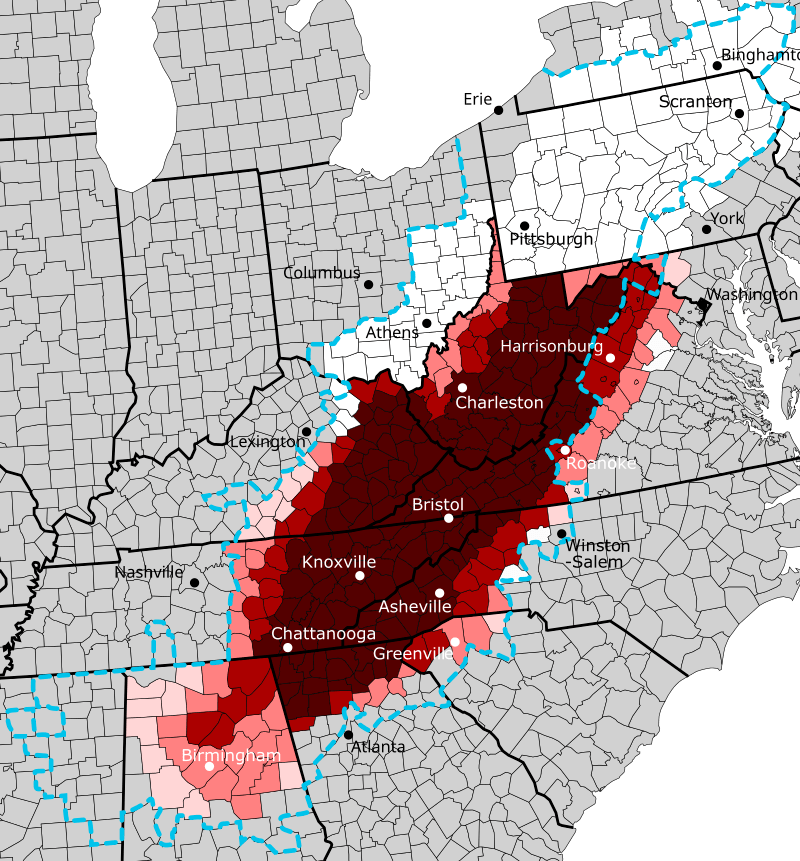
    Appalachia is a geographical region that, according to the U.S. government’s Appalachian Regional Commisssion, is made up of 423 counties in 13 states.


    Cultural definitions of Appalachia: Burgundy color –  Always included in Appalachia. Red color –  Usually included.  Salmon color – Sometimes included. White color – Rarely included,  physically contains the Appalachian Mountains or associated features; not culturally Appalachian The blue dotted line encloses the counties included in the ARC definition.


    Many social media creators who post about Appalachia define Appalachia as being only eastern Kentucky, eastern Tennessee, and western North Carolina. But if you ask almost anyone who grew up or now lives in any of areas on the above map colored burgundy, red or salmon, they will say they are from Appalachia. (I grew up in Hall County, Georgia, full of poultry processing plants and known as the Poultry Capital of the World, which is in the salmon-colored area, but I now live in White County, Georgia which is in the burgundy-colored area. My daughter and her family live in Whitfield County in northwest Georgia, full of carpet mills and known as the Carpet Capital of the World.)

    Much more than a geographical region with stunning natural scenery, Appalachia is a cultural region influenced by European, African, and Native American traditions. (And many people carry the DNA of all three.) There are unique storytelling traditions, superstitions, folklore, traditional musical styles, and crafts. People from other parts of the country think there is one Appalachian dialect, but in fact, there are many differences depending on the area in which people live. People in northwest Georgia speak differently than people in northeast Georgia. I can hear differences depending on whether people are from Northern Alabama, Western North Carolina, upstate South Carolina, or eastern Tennessee.

    Religion always has been important in the region, and churches can be found on almost every corner in small towns, along every highway or county road, and at many crossroads. However, a little-known fact is that Jews have been here since the beginnings of settlement, and many Southerners, like myself, are discovering our Jewish roots.

    In this blog, I hope to explore Appalachian heritage, Jewish heritage in Appalachia, and what it means to live as a Jew in Appalachia today.