Tag: Appalachia

  • My Journey Back to Judaism, the Faith of My Ancestors – Part 2

    My Journey Back to Judaism, the Faith of My Ancestors – Part 2

    Jewish beginnings


    Even though I was raised as a Christian and was immersed in Christianity, ever since I was a small child there was another track running through my life. I felt that I was Jewish and wanted to be part of the Jewish people.

    I didn’t know how I knew this; it was just a knowing. I believed I was someone born with a Jewish soul, although I wouldn’t have used those words when I was a child.  In my child’s mind, I thought I was a Jew who had been born into the wrong family. But as I listened to my mother, I realized she was dropping hints.

    My mother made it clear that she named each of her children for people from the Hebrew Scriptures.  She also spoke of going to Jewish summer camp when she was young. That, of course, leads to the inevitable question of who in a small town in the South would send their daughter to Jewish summer camp in the early 1940s unless they were Jewish?  When I was old enough to go to camp she sent me to a secular camp where a large number of campers were Jewish.

    When I was older, my mother helped manage the book and gift shop at the local Episcopal Church. Her inventory there included this wall hanging, which is now in my home…


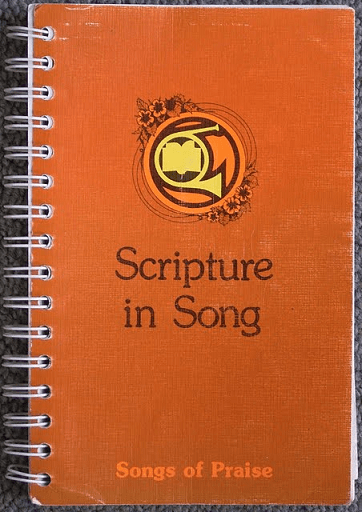
    The shop also sold cassette tapes and songbooks from the series “Scripture in Song,” musical settings of the Psalms.


    I now know that my father, too, had Jewish ancestry, but I didn’t pick up on his hints when I was young. He said only that he had Black Dutch ancestry and that his grandmother told him that anyone who researched the family history would be cursed and die a horrible death. The term Black Dutch is often used as a euphemism for Sephardic Jewish ancestry from Spain.

    My father also had a love for Israel that went beyond any I had ever seen among Christians. Tithing ten percent of his income was central to his spirituality, and he found a way to pay a tithe from the profits of his business directly to Israel. An inventor and manufacturer of the chicken deboning machine, he sold that machinery around the world. However, every tenth machine that was manufactured was given to a kibbutz in Israel, and he personally escorted the machines to the kibbutzim.

    After his death, a former colleague told me that my father often spoke to her about being Jewish, but he never told his own children, and he lived his life as a very devout Christian.

    Both of my parents had been in musical theatre (my mother’s dream had been to be on Broadway), and they made many trips to New York to see Broadway shows. This was in the late 1950s and early 1960s. On one occasion, after their return from New York, I overheard my mother tell someone that they had been denied service in a restaurant because they were Jewish. I wondered then how anyone would know they were Jewish and why they had not simply said they weren’t Jewish.  They always denied being Jewish whenever I asked directly about it. I remember once saying I wanted to be Jewish, and my mother’s response was, “Why do you want to be something you’re not?” 

    I wanted to know who I was…


    There weren’t very many Jewish families in my small hometown when I was growing up, but my mother made sure I knew who all of them were, and they seemed to know my family well. I was only in first or second grade when I learned about the Holocaust and about the Jews in my town who had come to the U.S. as refugees.

    When I was in 4th grade, the mother of one of my Jewish classmates called my mother to ask if I could go to the movies with her son. My mom said yes, and that began a friendship that lasted for several years. By 7th and 8th grade, he and I were considered to be boyfriend and girlfriend, and I became close to his entire family. At the time,  I.D. bracelets were popular among boys, and I wore his bracelet which was obviously Jewish, with the Star of David on it and his name in Hebrew. My friends’ mothers would never have allowed them to wear such a bracelet. When he had his Bar Mitzvah in Atlanta, we were the only family in our town that was invited.

    In college my closest friends were Jewish, and people have always assumed I was Jewish. After graduate school, I worked for several years as a civil rights investigator, investigating employment and housing discrimination, and members of the Jewish community with whom I worked just assumed I was Jewish. Here in the South, oddly enough, perfect strangers have walked up to me and asked if I’m Jewish.  (Why?) Yet no one in my family would openly admit having Jewish ancestry.

    I still have many questions about all of this. It has been like trying to put a puzzle together and realizing that there are many missing pieces. Unfortunately, there is no one who can provide answers. No one is still alive who would be able to give me any more insight than what I already have gleaned.

    One thing I did know for sure, however, and that was that I wanted to claim my Jewish ancestry and live a Jewish life.


  • My Journey Back to Judaism, the Faith of My Ancestors – Part 1

    My Journey Back to Judaism, the Faith of My Ancestors – Part 1

    Christian beginnings

    Born into a privileged and prominent family in a small town in North Georgia in the foothills of Appalachia, I was raised a Christian, as were both of my parents.  However, I’ve known for most of my life that I have Jewish ancestry.  It has taken a lifetime , but I have finally been able to put the puzzle pieces together and to fully realize that both of my parents were “hidden” Jews, known only to a few people, and those few did not include their own children.

    All four of my grandparents were nominal Christians, but not one was a regular church goer. My father was born into a large family in what has been described as abject poverty, and to keep him on the straight and narrow, his oldest sister took him to the Methodist church. He grew up faithfully attending that church.  My mother’s parents made sure she and her sisters faithfully attended a Southern Baptist church.

    When my parents married, they joined the local Episcopal Church and became very active there. My siblings and I became what is known as “cradle Episcopalians,” baptized there as babies, confirmed there, and very active in children’s and youth activities as we grew up.

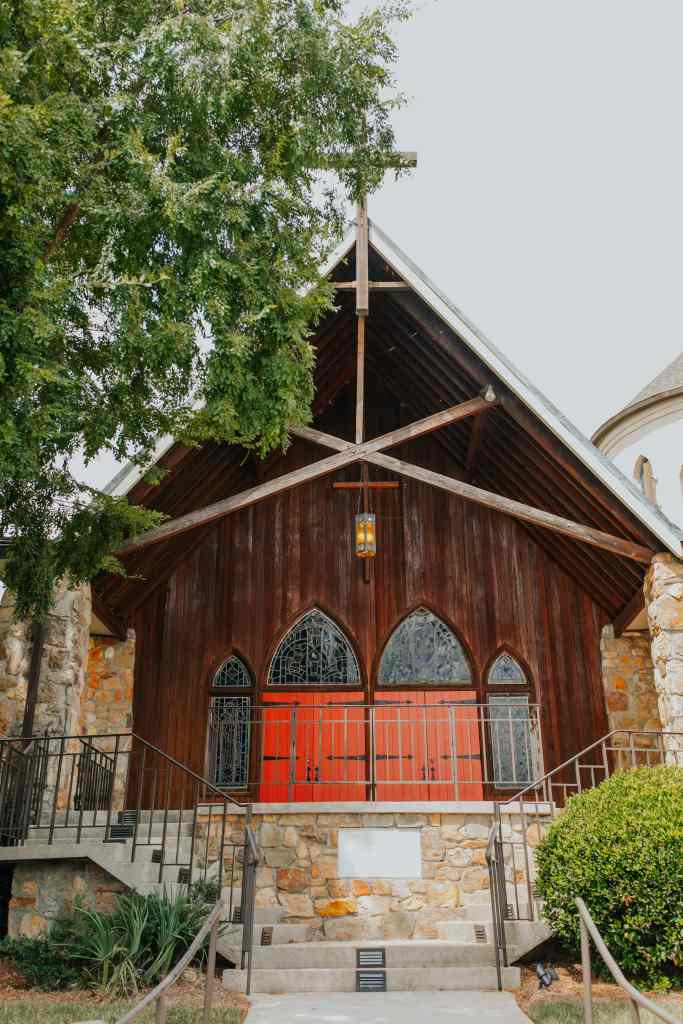
    My earliest memories are of Grace Episcopal Church in Gainesville, Georgia. My family faithfully attended church every Sunday, and both of my parents were very active in the parish. As a youngster I regularly went to Sunday school, sang in the youth choir, and participated in youth activities. When I look back I can see that even as a child, I was already very spiritual. I felt the presence of God with me. I loved to read the Bible, especially the Hebrew Scriptures, and I particularly loved the Psalms and the writings of the Prophets.


    Grace Episcopal Church as it looked during my childhood.


    As a denomination, the Episcopal Church has always been more progressive and more involved in social justice issues than other Protestant denominations. Grace Church had a very active youth group that did a lot of work in the area of social justice when I was in high school. That work had a massive influence on my life, both then and later. And by the time I was in high school I was already teaching younger grades in Sunday school and was playing the piano for and traveling with a Black gospel choir, all of whose members went to the Black high school while I attended the all-white high school, as the schools in Gainesville were still segregated.

    Playing the piano at the age of 15 and 16 for the gospel choir is a story in itself, as I essentially led a double life. My parents supported the 1960s civil rights movement and were labelled as “communists” by some in my small town. My white friends had no idea my family was as active as it was in the Black community. I managed to hide that part of my life quite well, as it could have been dangerous to let that be known.

    At this same time, my parents made the move into more evangelical, Pentecostal Christianity, becoming “saved” and “born again,” even while staying in the Episcopal Church.  They took me and my siblings to every Pentecostal church, evangelical meeting, healing service, “miracle” service, and revival meeting that they could find. Both parents became well-known retreat leaders and speakers and were involved on the local, state, national, and even international levels in various evangelical organizations. 

    I now see how spiritually damaging this was to me and my siblings. We were going to services that were highly emotional.  We saw people “get saved,” fall out on the floor, be “delivered” from demons, run up and down the aisles and speak in “tongues,” and we were expected to follow suit.

    We continued to attend the Episcopal Church, which although socially progressive, was very staid and formal to the point that  Episcopalians were known as “G-d’s frozen people.” I am the eldest and perhaps suffered less than my younger brother and sister, both of whom still struggle with religion to this day.

    College and beyond

    Once I was away from this and in college, I remained in the Episcopal Church even as I began questioning my Christian beliefs. In fact, I remained an active Episcopalian for decades, always wondering why I could not accept certain core Christian beliefs.

    After college, I worked as a newspaper reporter for three years before moving to South Bend, Indiana for graduate school at the Medieval Institute at the University of Notre Dame, studying medieval history, literature and music.

    Studying the world of late antiquity, the development of Christianity, how Jesus became “G-d,” the emergence of the Catholic tradition, Catholic theology, and the medieval church, I began to have multiple doubts about the Christian faith. Questioning was not allowed, and one of my professors told me my beliefs were heretical.

    However, in medieval music classes, we studied the influence of synagogue chant on early Christian chant, and I was captivated by what I learned there.


    While in graduate school I remained in the Episcopal Church. My late husband and I met at the Episcopal cathedral in South Bend and were married there but became members of a smaller parish where our daughter was baptized and confirmed.

    I became the church musician for about four years, playing the guitar and leading the singing of all liturgical music and hymns. When an organist was finally hired, he and I continued to sing together.  Interestingly, apart from the liturgical music itself, most of the songs were based on the Psalms and writings of the prophets, and we often sang in English what I now know to be the Jewish song of redemption, Mi Chamocha.

    Years later, after moving to the North Georgia mountains in rural Appalachia, we immediately joined the local Episcopal church where we were very active.  I was a Sunday school teacher and was one of the people who read Scripture from the podium during the service.  There were three readings every week.  I always chose to be the person who read the “Old Testament” Scripture. 


    Interestingly, as I made my journey into Judaism, the priest of the parish and my friends there, along with my daughter (who is married to a Christian minister), were my biggest supporters.

  • The word “Melungeon”: Another explanation

    The word “Melungeon”: Another explanation

    In a previous post I stated that the origin of the term Melungeon is unknown and that it has been suggested that the word comes from an Arabic word meaning “cursed souls” or from the French word “mélange” for mixed race.

    However, today I came across another explanation for the origin of the word. In his book Recipes From the American South, Michael W. Twitty states that Melungeons are “an ethnically-mixed community dating back to the 17th century, descended from enslaved Africans, indentured European servants, and others (and here I would add Native Americans and Spanish soldiers in Appalachia) living in Southern Appalachia and beyond.”

    He continues, “The word comes from Mbundu from Angola, mulango, meaning “shipmate.”

    Twitty is an African-American Jewish writer, educator, culinary historian, and author of the book The Cooking Gene.

    His explanation of the origin of the word Melungeon is fascinating to me because I am of Melungeon descent, and my African American ancestry is from Angola.

  • The Melungeons: Conversos, Crypto-Jews and Hidden Jews in Southern Appalachia – Sources

    The Melungeons: Conversos, Crypto-Jews and Hidden Jews in Southern Appalachia – Sources

    Understanding that many people will question the stories about Melungeons and the hidden Jewish heritage in many Melungeon families, I am including here some of the sources I utilized in writing my previous posts. In addition to these sources, I also drew on family stories and other information that I have gathered over many years of research.


    Sources

    Cohen, Marcia and Greenberg,  Mark I. Jewish Roots in Southern Soil: A New History.Brandeis University Press, 2006.

    Gallegos, Eloy J. The Spanish Pioneers in United States History: The Melungeons, the Pioneers of the Interior Southeastern United States. Villagra Press, 1997.

    Gerber, Jane S. The Jews of Spain: A History of the Sephardic Experience. The Free Press, 1994.

    Gutierrez, Juan Marcos Bejarano. Secret Jews: The Complex Identity of Crypto-Jews and Crypto-Judaism. Yaron Publishing, 2017.

    Hirschman, Elizabeth Caldwell. Melungeons: The Last Lost Tribe in America. Mercer University Press, 2005.

    Hirschman, Elizabeth Caldwell, and Donald N. Yates. When Scotland Was Jewish. McFarland and Company, 2007.

    Jarvis, Judith J., et al. Book of Jewish and Crypto-Jewish Surnames. Panther’s Lodge Publishers, 2018.

    Kennedy, N. Brent. The Melungeons: The Resurrection of a Proud People. Mercer University Press, 1997.

    Kessel, Barbara. Suddenly Jewish: Jews Raised as Gentiles Discover Their Jewish Roots. Brandeis University Press, 2000.

    “Ku-Klux Klan Holds Annual Ceremonial.” Atlanta Journal, 7 May 1920, p. 10.

    “Much Local Interest Knights Ku Klux Klan.” Columbus Ledger, Columbus, Georgia, 9 Aug. 1920, p. 2.

    Oney, Steve. And the Dead Shall Rise: The Murder of Mary Phagan and the Lynching of Leo Frank. Vintage Books, Random House, 2004.

    Shapiro, Rabbi Merrill. “Early Crypto-Jews, Conversos and Marranos of Florida.” Museum of the Southern Jewish Experience, 20 Dec. 2023, New Orleans, Louisiana. Webinar.

    Solnick, Joseph M., and N. Brent Kennedy. From Anatolia to Appalachia. Mercer University Press, 2002.

    Thornton, Richard L. “17th Century English Knew About Sephardic Gold Mines in the Appalachians.” The Americas Revealed, 19 Jan. 2020, apalacheresearch.com/2020/01/19/17th-century-english-knew-about-sephardic-gold-mines-in-the-appalachians/.

    Thornton, Richard L. “The Juan Pardo Expedition Under a Magnifying Glass.” The Americas Revealed, 29 Jan. 2022, apalacheresearch.com/2022/01/29/the-juan-pardo-expedition-under-a-magnifying-glass/.

    Thornton, Richard L. “Why Do Archaeologists Refuse to Study Spanish and Jewish Colonial Era Sites in the Appalachians?” The Americas Revealed, 11 Feb. 2023, apalacheresearch.com/2023/02/11/why-do-archaeologists-refuse-to-study-spanish-and-jewish-colonial-era-sites-in-the-appalachians/.

    Thornton, Richard L. “LIDAR Identifies Site of 1646 Spanish Fort, Trading Post, and Mission.” The Americas Revealed, 9 Nov. 2023, apalacheresearch.com/2023/11/09/lidar-identifies-site-of-1646-spanish-fort-trading-post-and-mission/.

    Thornton, Richard L. “Footnote: Very Common for Cherokees and Muskogeans from WEST (sic) of the Ocmulgee River to Have Some Jewish Ancestry.” The Americas Revealed, 26 Nov. 2023, apalacheresearch.com/2023/11/26/footnote-very-common-for-cherokees-and-muskogeans-from-west-of-the-ocmulgee-river-to-have-some-jewish-ancestry/.

    Thornton, Richard L. “Sneak Preview of the Secret Spanish Fort in the Southern Appalachians.” The Americas Revealed, 2 Jan. 2024, apalacheresearch.com/2024/01/02/sneak-preview-of-the-secret-spanish-fort-in-the-southern-appalachians/.

    Winkler, Wayne. Walking Toward the Sunset: The Melungeons of Appalachia. Mercer University Press, 2005.

    (2020, December 3). 20 Years of Melungeon Research. dnaconsultants.com. https://dnaconsultants.com/20-years-of-melungeon-research/

  • The Melungeons: Conversos, Crypto-Jews and Hidden Jews in Southern Appalachia – Part 5 , DNA Evidence

    The Melungeons: Conversos, Crypto-Jews and Hidden Jews in Southern Appalachia – Part 5 , DNA Evidence

    The stories of Spanish forts, towns, and mines in the Appalachian wilderness, the Yuchi/Creeks providing towns of refuge for Sephardic Jews, mysterious people in Appalachia, intermarriage with other incoming Europeans (many of whom may have been Sephardic Jews) – all of this at first glimpse seems like flights of fancy and legends. Some Melungeon researchers have been discounted and labeled as “crackpots,” and many have had to self-publish their findings. However, DNA testing has supported their claims of Iberian and Sephardic Jewish ancestry.

    The first DNA testing

    The first DNA testing of Melungeons was done in 2000, using hair samples of known Melungeons to test mitochondrial DNA, the female lines. The study was conducted by Kevin Jones, an English biologist, working with the University of Virginia’s College at Wise, VA and with University College in London. Results verified that Melungeons are a tri-racial group with European, African and Native American ancestry.

    In 2003 Dr. Donald Yates, himself of Melungeon descent, formed DNA Consultants specifically to determine an overall ethnic profile for Melungeons. The company used the cheek swab test offered at that time through Family Tree DNA to show from what parts of the world Melungeon ancestors came and the amount of admixture from Native Americans and Africans.


    All Melungeons who participated had Appalachian ancestry over the previous five generations and a surname from the list of the most common Melungeon surnames. Those results showed elevated Iberian, Middle Eastern, Native American and Sub-Saharan African ancestry, confirming that Melungeon ancestry is heavily Mediterranean and “browner” than that of their Northern European neighbors.

    Scottish Sephardic ancestry

    In addition, Yates believed that many of the 17th and early 18th century Scottish and Scots-Irish immigrants to America had Sephardic Jewish ancestry. He obtained DNA samples from known Melungeons and from two donors of each of nine Scottish families whose surnames are found among the Melungeon population.

    Yates himself had recently discovered his own hidden Jewish roots, is now a practicing Jew, and had corresponded with many of his DNA cousins who also had discovered that Judaism had been practiced in their families until fairly recently.

    The results of that study were published in 2007 and showed that the DNA locus for the Scottish families was centered in Spain and Portugal. Some of the Melungeons and the Scots tested showed exact matches to living people who self-identified as Jews.

    (One of the Scottish families tested was the Alexanders.  Yates traced the history of the Alexander family and found they arrived in Scotland during the early years of the Spanish Inquisition and settled in Stirling. Many Alexanders came to America through the colony of Maryland. My father had Alexanders in both his maternal and paternal lines, and they arrived in colonial Maryland from Stirling, Scotland.)


    My DNA results

    My own DNA testing with every major company and several smaller companies has confirmed that my Melungeon ancestry is tri-racial: European, African and Native American.

    In spite of the fact that I was told that all of my known and documented ancestors were from the British Isles and France and came to this country in the 1600s and early 1700s, I have substantial Spanish/Portuguese ancestry and also North African, Middle Eastern, Balkan, and Eastern European.

    Although DNA testing cannot conclusively prove Jewish ancestry, I have DNA relatives who have specifically self-identified as being Jewish from France, Morocco, Iraq, Greece, Turkey, and Yemen, and I am a close match with Jewish populations in Ukraine and Poland as well.

    My African ancestry is from present-day Angola and Congo, areas from which the Portuguese and Spanish obtained slaves as early as the 1500s. 

    A neighbor of mine who is of Yuchi/Creek descent, a member of the Creek nation, and a researcher of the Spanish forts and towns that were in the area where I live, helped me use specific DNA markers to verify that I am of Yuchi descent. It was the Yuchis who provided refuge to the Spanish soldiers, settlers and miners, many of them believed to be the Conversos or Crypto-Jews who were abandoned in the interior of Appalachia.

    A few final thoughts

    Additional research remains to be done on the Melungeon people. Much of the research that exists was done in the 1990s and early 2000s but has now stalled due to the disagreements among Melungeon descendants as to who is a true Melungeon.

    However, the fact remains that many Melungeons have Jewish ancestry, although they may not be aware of it.  Others know their ancestors were practicing Jews who at some point chose to hide their Judaism and convert to Christianity or chose simply to have no religious faith at all. And some, like myself, had parents who knew they were Jewish, dropped hints to their children, but denied being Jewish when directly asked about it.

    There are many questions yet to be answered. The mysterious Melungeons are still mysterious in many ways, but Melungeons are not the stuff of Appalachian legend.  We are here and have been here for over 400 years, and many of us are embracing our Jewish ancestry.

  • The Melungeons: Conversos, Crypto-Jews and Hidden Jews in Southern Appalachia – Part 4 , Rediscovering Jewish Origins

    The Melungeons: Conversos, Crypto-Jews and Hidden Jews in Southern Appalachia – Part 4 , Rediscovering Jewish Origins

    Modern-day Melungeons who are rediscovering their Jewish ancestry are faced with asking:

    • For how many generations was my family aware of their heritage?
    • How was this information transmitted and by whom?
    • Is it anywhere written down, preserved or recorded?
    • Who else knew about us, and what did they know?
    • When and how were decisions made to bury this information?
    • Is it even possible for a family to have held onto vestiges of this heritage and passed them down for 500 years?

    The answer to that last question is yes.  For her book Suddenly Jewish: Jews Raised as Gentiles Discover Their Jewish Roots, Barbara Kessel interviewed descendants of Spanish settlers of the American Southwest. 


    Many of the original Europeans in the Southwest were Crypto-Jews who lived outwardly as Catholics but secretly as Jews, and their descendants are just now learning about their true heritage.  Many are converting to Judaism. Kessel quoted one interviewee as saying, “…five hundred years and now I find myself home…You can be away five hundred years and then come home… Nobody said Kaddish (the Jewish Mourners’ Prayer) for this family for five hundred years.  This will be my project.” 

    If families in the Southwest can hold onto and pass down, even in small ways, information about their heritage, it certainly can also be true of Melungeon families in Appalachia.

    Also from Kessel’s book, “Parents who deny their Jewishness inevitably send out signals.  They leave clues that their children pick up on, though neither side – parent or child- may be consciously aware of what is happening.” 

    Kessel quotes Canadian psychiatrist Robert Krell, “I think it’s hard for parents not to, from time to time, give a hint.  There may be a thousand slips of the tongue which the child does not connect to being Jewish.  Yet there is a subtle awareness.  The question becomes: when does the observation get crystallized by the child into the construct,’Perhaps I am a Jew?’”


    My Family’s Journey

    I often wonder when in my family the decision was made to hide our Jewish heritage. I now know that I am Melungeon and Sephardic (Jewish from the Iberian peninsula, that is, Spain and Portugal) on both sides of my family and also Askenazic (Jewish from Eastern Europe) on my father’s side.

    Both my mother and my father knew they were Jewish but hid that fact and lived as Christians. My grandparents were nominal Christians, as were some of my great grandparents. Whatever led my family to decide to hide their heritage, that decision was certainly cemented in the early 1900s.

    One of my great grandfathers, an attorney and newspaper editor and publisher, was serving in the Georgia State Legislature in 1913-1914 during the time of the arrest and trial of Jewish businessman Leo Frank. My great grandfather was described in Atlanta newspaper reports as being “broad and liberal in his views,” and he was noted for voting for progressive legislation. He would have been well-known by other newspaper editors and prominent politicians of his day.


    My great grandfather, Travis Glenn Dorough


    Leo Frank, who was the Jewish superintendent of a factory in Atlanta, was found guilty of murder and sentenced to death in August, 1913. In 1915, the governor of Georgia commuted Frank’s sentence to life in prison. By that time anti-Semitism was rampant in Georgia, a former governor was calling for the people to form mobs, and my great grandfather was no longer serving in state government. On August 17, 1915, a lynch mob literally attacked the state prison where Frank was being held, transported him 150 miles, and hanged him.

    (Evidence later uncovered, although not conclusive, pointed to another man as the murderer, and in 1986, Frank finally was granted a posthumous pardon.)


    Leo Frank (Photo credit: https://thebreman.org/research/leo-frank/)


    In the aftermath of the lynching, lawyer, newspaper editor and politician Tom Watson called for a revival of the Ku Klux Klan in Georgia and throughout the South. The Klan sought a charter from the Georgia Secretary of State and was officially revived in November of 1915.

    By 1920, Tom Watson was serving in the U.S. Senate and declaring himself to be “King of the Ku Klux.” Klan chapters were being organized throughout the South, and Klan marches were being held in major cities. Watson, now an open racist and member of the Klan, had once been seen as the progressive leader of the Populist Party in Georgia, the party of which my great grandfather had been a member.


    Tom Watson (Photo credit: https://www.georgiaencyclopedia.org/articles/history-archaeology/thomas-e-watson-1856-1922/)


    I don’t know if my great grandfather was Jewish, but my great grandmother had Melungeon and Jewish ancestry, and it was in 1920, in the midst of KKK threats and marches that my great grandparents loaded up their 6 daughters in a wagon and fled in the night to another county in North Georgia where they felt they would be safer. One of those daughters, Annie, was Black and had been taken into the family as a child. My grandmother told me that Annie was raised as their sister.

    My father’s family was in North Carolina and would have faced similar threats. My father’s grandmother always insisted they were “Black Dutch,” and warned my father against ever researching his ancestry.

    Thus, families that had not already hidden their Jewish ancestry certainly began to hide it in the 1920s.