Today, March 14 2026, is the second anniversary of my conversion to Judaism.
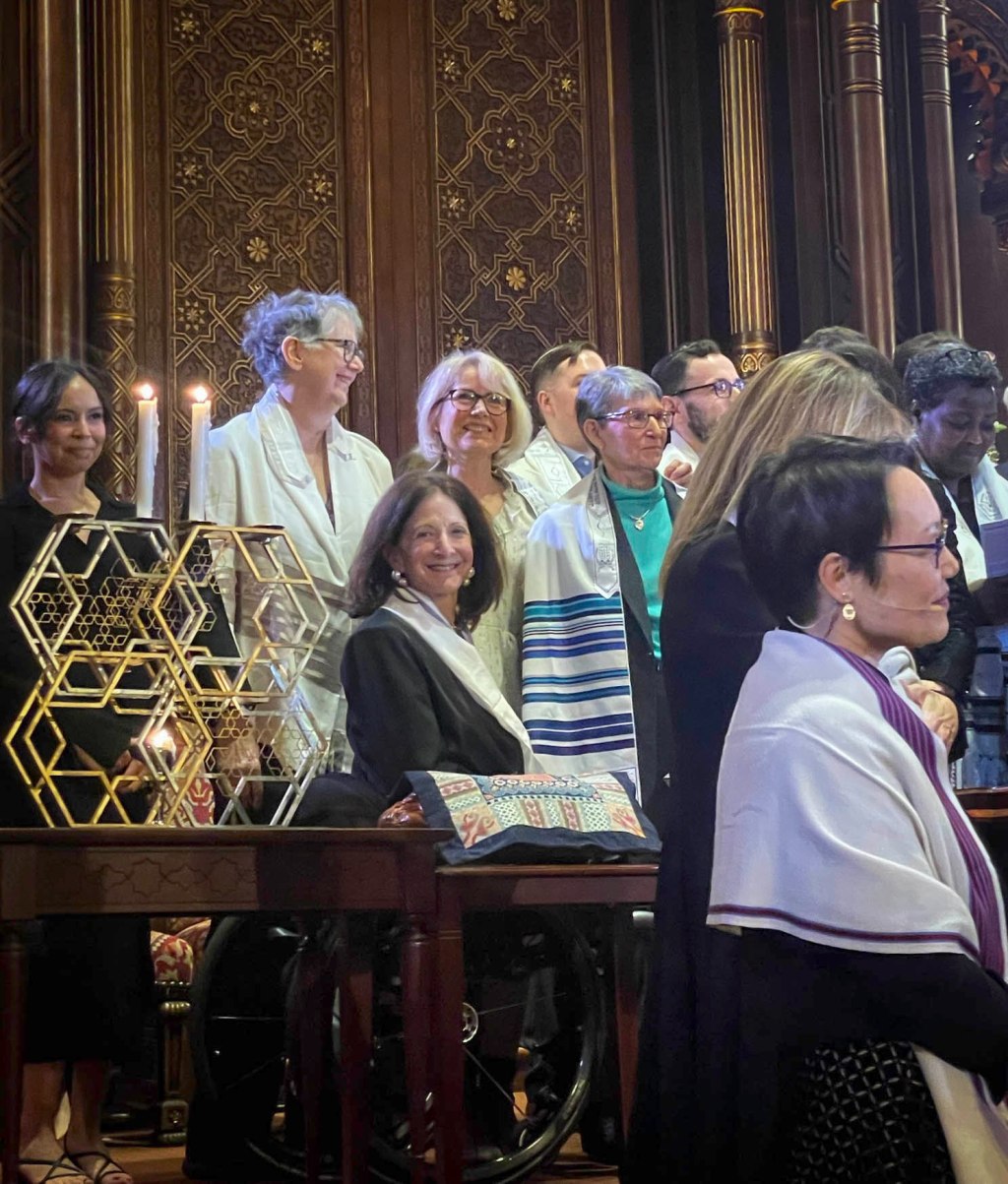
The day after conversion, along with others who had converted during the previous year, I was on the bimah at Central Synagogue in New York City during the Friday evening Shabbat service to be recognized and to receive the priestly benediction from Senior Rabbi Angela Buchdahl (bottom right). I am in the turquoise turtleneck.
I received this photo today from my friend and conversion colleague Rosemary, who is seated in a wheelchair and is looking directly at the camera. Her husband took the photo, and today is the first time I have seen it.
Livestreaming services from Central Synagogue in New York is what made me aware that there was a path by which I could convert to Judaism.
Central Synagogue has a Center for Exploring Judaism, established in 2010 and geared mainly towards those with a Jewish partner or spouse, helping them to understand the Jewish faith and what it means to live a Jewish life. But the program also is open to individuals who desire to explore Judaism. Originally, all classes were held in person at the synagogue, but in recent years online cohorts have been comprised of people literally from around the world.
In late Spring 2023, I contacted Rabbi Lisa Rubin, director of the Center for Exploring Judaism to ask about being accepted into the program. What fascinated me about the hour-long interview with her was that one of the first things she said to me was that she was wondering why a Jewish person (me) would want to be in a cohort group. She considered me to be already living a Jewish life. When I explained that I had been raised as a Christian by parents who also were raised as Christians (even though they knew they were Jewish), she agreed that actual conversion would be the proper course of action for me.
My cohort group consisted of about 40 people from throughout the U.S. and from several other countries. Classes extended over a six-month period from July through December 2023, met once a week on Zoom, and were conducted like university classes. We had a syllabus, several required books, and weekly assignments and were expected to actively participate in class discussions and complete two projects . Both projects could be submitted after classes ended, but no one could be considered an actual candidate for conversion until both were turned in. In addition, each of us had to meet individually on Zoom with Rabbi Rubin on a regular basis.
The following is from Central Synagogue’s website:
Summary of the Conversion Process
1. Initial meeting with Rabbi Lisa Rubin, our Director of the Center for Exploring Judaism In this introductory meeting, we will discuss your background and interest in Judaism and do our best to ascertain whether our program may be a good fit for you.
2. Enrollment in our Exploring Judaism course Our course covers the foundations of Judaism: holidays, history, prayer, theology, and life cycle. A new class begins every other month and we meet weekly for a six-month period.
3. One-on-one meetings with Clergy These regular meetings (during the six-month period of the Exploring Judaism course) are for individual guidance and mentorship.
4. Extended study after the course Conversion candidates are encouraged to study with a rabbi as long as is needed to attain confidence with a basic “literacy” of Judaism. Time will vary with each student.
5. Completion of a conversion project and spiritual autobiography Students are asked to complete two small projects toward the end of the conversion process.
6. Bet Din and Mikveh A bet din (rabbinic court) will be assembled on the day of your conversion followed by a visit to the mikveh (ritual bath).
I submitted my second project in February 2024, thinking I probably was the last person in my cohort to submit their work, but this turned out not to be the case. In addition, I had been under the impression that each of us would be assigned to another rabbi at Central Synagogue to continue studies until such time as that rabbi determined we were ready to complete conversion. That also turned out not to be the case for me.
As soon as Rabbi Rubin had my second assignment in hand she asked me when I could come to New York to complete my conversion.
Conversion
I made the trip to New York in mid-March 2024 and formally converted to Judaism on March 14. Unlike in Christianity, in which conversion is often a public event including baptism witnessed by friends and family, conversion in Judaism is a private event involving only the convert and three rabbis.
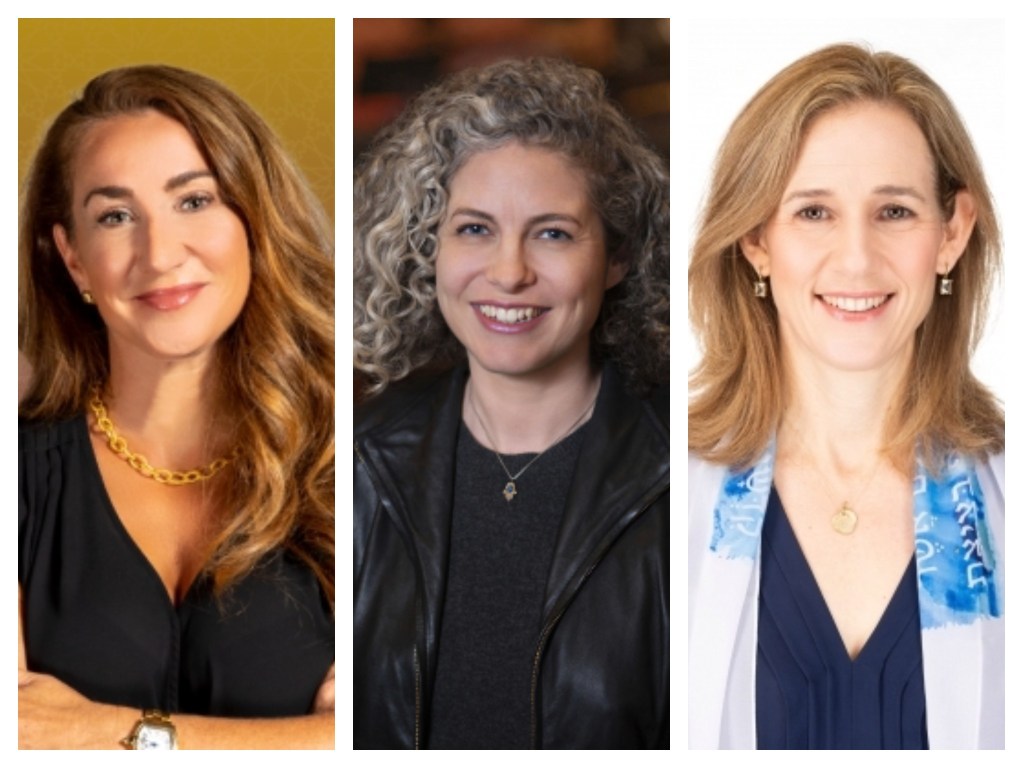
My Bet Din, or rabbinic court, consisted of three female rabbis, all of whom teach in the Center for Exploring Judaism.
(Two other members of my cohort converted on the same day and one had a different configuration of rabbis on her Bet Din.)
I expected an intimidating scene in which I would be grilled by the rabbis on various aspects of Judaism, but it turned out to be a delightful discussion. All three rabbis considered me to be living a Jewish life and told me that they saw me not so much to be converting as returning to the faith my ancestors had once practiced but that had been hidden for several generations.
As part of my conversion I was formally given my Hebrew name, which, as an adult, I had chosen. I kept my given name, given to me at birth by my mother who had named me for a heroine in the Hebrew scriptures, but I changed my middle name from Leigh (Leah) to Shira, a name that means song because I have always been a singer. דבורה שירה
Immersion in the mikveh, the ritual bath, is an integral part of conversion. Central Synagogue uses the community mikveh on the Upper West Side in Manhattan. Those coming to the mikveh enter from the street through a rather non-descript door to find a beautiful, spa-like atmosphere inside. As a convert, I immersed in the mikveh’s warm water alone, completely submerging three times and saying a specific blessing after each immersion. The rabbis waited outside the door and greeted me with a rousing chorus of Siman Tov Mazel Tov.
Here’s what that sounds like…
Afterwards, I was given the priestly benediction and was declared to be officially a part of the Jewish people.
The priestly benediction can be heard here, beginning at about 3:11 in the video. Here, Central Synagogue’s Senior Rabbi Angela Buchdahl gives the blessing to former Supreme Court Justice Stephen Breyer who had been interviewed at the synagogue…
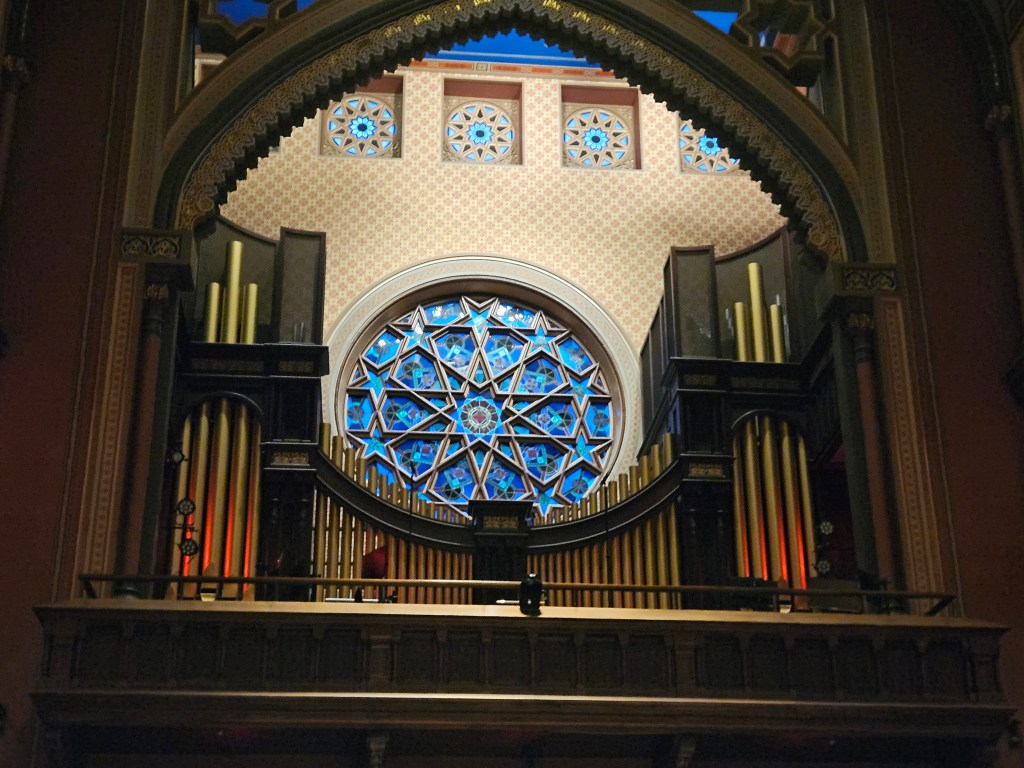
The evening following my conversion was a Friday, and at Central’s Friday night Shabbat service, I along with many others who had converted at Central Synagogue in the preceding twelve months, was called to the bimah (the platform at the front of the synagogue) to bless the reading of the Torah and to receive the priestly benediction.
In this photo, which features Rabbi Rubin from the Center for Exploring Judaism, I am among the group on the bimah although, because I am so short, I cannot be seen.
I returned home from New York a different person, knowing for certain what I had “known” all of my life, that I was, in fact, a Jew. I finally was where I belong.
The following song from Temple Israel Westport expresses what I had always known. Written and sung by Cantor Becky Mann, on the left, joined by Cantor Julia Cadrain (formerly at Central Synagogue) on the right, it says, “You’ve always belonged here.”
In the late 1990s, after my husband, daughter and I moved from Indiana back to the area where I grew up in Georgia, my interest in Judaism increased. Even though I was active in the Episcopal Church, I wanted to identify more as Jewish. I joined a Jewish book club and began reading and collecting a library of books about Judaism and what it means to live a Jewish life, without even knowing anyone here in North Georgia anymore who is Jewish.
Fast forward to 2018, I was following a blogger in California, a rabbi who called herself the Coffee Shop Rabbi, and she posted a list of synagogues in the U.S., by denomination, that were livestreaming their services. I decided to try livestreaming the Friday evening Shabbat (Sabbath)service from Central Synagogue, a large Reform congregation in Manhattan in New York City.
There are no words that can adequately describe how I was affected by that first service I watched. It was as if I had heard the songs and the prayers before, even though I never had. They reached something very deep within my soul, as if it were in my very DNA, and I felt the presence of God in an almost palpable way. It was as if I had come home at last, as if this is who I am, who I’ve always known myself to be, and I wept through the entire service.
I continued to livestream services from Central Synagogue and immersing myself in Judaism. I ordered the Mishkan Tefillah Siddur, the Reform prayerbook, so I could follow along during services. I began to light Shabbat candles on Friday evenings and to make challah, the braided bread that is eaten on Shabbat.
And I have long had mezuzahs on my front and back door posts.
Because music always has been an important part of my life, I created a Spotify playlist which now contains over twelve hours of Jewish music.
In addition, one of my brother’s friends (who I did not know until recently is Jewish) told me about the small Jewish community, Shalom B’Harim, here in Northeast Georgia. I am now a part of that community which meets once a month in a church building about 25 miles from me. The rabbi drives two hours from Atlanta to get here. Services may be on Friday evenings or on Saturdays, and we rely on emails to let us know when the next service will be held.
Non-denominational and without actual membership or dues, Shalom B’Harim only draws about 25 to 30 people each month from six counties in Northeast Georgia. The High Holiday services draw about twice that number. I’ve only met one person there who grew up in this area. Everyone moved here from other parts of the country, either for work or to retire in the mountains, and they still seem puzzled about my growing up here and my having known, so long ago, the Jewish families in my hometown.
The same person who introduced me to the local Jewish community also introduced me to My Jewish Learning, and I’ve taken advantage of some of their programs, such as the Mi Shebeirach Moment (healing service) once a week and their online Zoom courses on Jewish Spirituality and Turning Toward Teshuvah (repentance).
Three years ago, I asked if I could become an actual member of what Central Synagogue in New York calls The Neighborhood. It is the first such outreach program in the history of Judaism in which they have a rabbi assigned to a large, disparate group of livestreamers from around the world.
I began partaking of everything I could that is offered by The Neighborhood, Zooming the Saturday morning Mishkan services, attending Wednesday Torah study, webinars, Neighborhood block parties, and other programs offered by Central’s rabbis. In 2023 and 2024, my daughter and I made the trip to New York for Central’s Neighborhood Homecoming.
My Jewish ancestry
I mentioned above that the first time I livestreamed a service from Central Synagogue, I felt as if the prayers and music were in my DNA. The truth is that I do have Jewish ancestry on both sides of my family.
Although there is no such thing as “Jewish DNA,” I now have confirmed my Jewish ancestry by doing research and through autosomal and mitochondrial DNA testing with multiple companies that show how my DNA relatives self identify and the populations to which I am most closely related. My father also tested (but died before he knew his results), as did his brother, several of my cousins, my half sister, nieces and nephews, and my mother’s sister.
On my father’s side, I have Sephardic ancestry from Spain and Portugal and Ashkenazi ancestry from the area of Eastern Europe that was known as the Pale of Settlement, the only part of the old Russian Empire in which Jews were allowed to live permanently. Today, that is the western part of Russia and the countries of Ukraine, Belarus, Poland, Lithuania and Moldova. My closest DNA markers there are Ukrainian.
On my mother’s side, through her maternal line, I have Sephardic ancestry from Morocco, Tunisia, Ethiopia, and Yemen.
Even though I was told as a child that my ancestry was almost 100% from the British Isles, fully half of my DNA is Spanish/Portuguese, North African, and Middle Eastern. The other half includes Western European, some of which appears to have been Jewish from Germany and France, and also Sub-Saharan African, and Native American.
Southerners are very good at hiding ancestry. My father always claimed that his family was 99% English and maybe 1% “Black Dutch,” descended from royalty. I now know that “Black Dutch” is a euphemism for a Sephardic Jew originally from Spain. My mother’s family was said to be 100% from the British Isles, but there is substantial amount of North African and Middle Eastern DNA.
Recently, I ran into someone I’ve known for many years who also knew both of my parents well. I asked her if she had known that my parents were Jewish, and her response was that she knew my father was, because he used to talk with her about it frequently. Yet he never told his own children.
I’ve struggled with this knowing that I am Jewish by ancestry but being told that I am not. Why would my parents and grandparents hide this? The only answer I have is the times in which my grandparents and great grandparents lived in the Deep South, a time of open activity by the Ku Klux Klan and rampant antisemitism after the lynching of Jewish businessman Leo Frank.
Returning
Until recent years I didn’t even know it was possible for someone raised as a Christian to convert to Judaism. I thought I would forever be someone on the periphery, someone with Jewish ancestry but not fully accepted as Jewish. However, once I learned that there was a path for me to become fully Jewish, to be accepted as part of the Jewish people, and to live a full Jewish life, I made the decision to convert, to return to the faith of my ancestors, to home.
Born into a privileged and prominent family in a small town in North Georgia in the foothills of Appalachia, I was raised a Christian, as were both of my parents. However, I’ve known for most of my life that I have Jewish ancestry. It has taken a lifetime , but I have finally been able to put the puzzle pieces together and to fully realize that both of my parents were “hidden” Jews, known only to a few people, and those few did not include their own children.
All four of my grandparents were nominal Christians, but not one was a regular church goer. My father was born into a large family in what has been described as abject poverty, and to keep him on the straight and narrow, his oldest sister took him to the Methodist church. He grew up faithfully attending that church. My mother’s parents made sure she and her sisters faithfully attended a Southern Baptist church.
When my parents married, they joined the local Episcopal Church and became very active there. My siblings and I became what is known as “cradle Episcopalians,” baptized there as babies, confirmed there, and very active in children’s and youth activities as we grew up.
My earliest memories are of Grace Episcopal Church in Gainesville, Georgia. My family faithfully attended church every Sunday, and both of my parents were very active in the parish. As a youngster I regularly went to Sunday school, sang in the youth choir, and participated in youth activities. When I look back I can see that even as a child, I was already very spiritual. I felt the presence of God with me. I loved to read the Bible, especially the Hebrew Scriptures, and I particularly loved the Psalms and the writings of the Prophets.
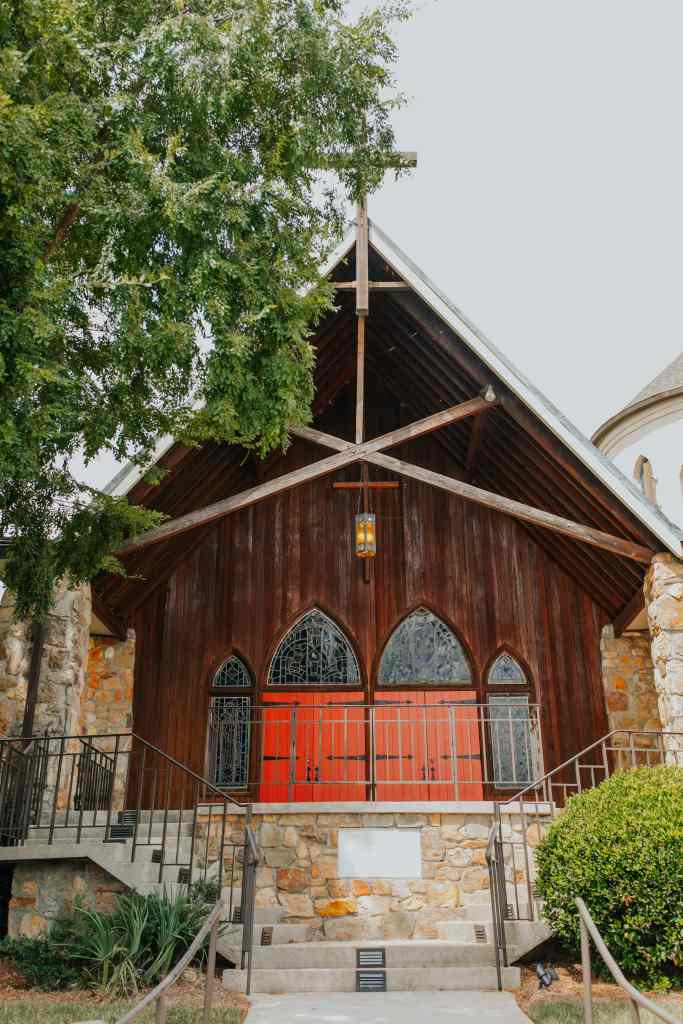
Grace Episcopal Church as it looked during my childhood.
As a denomination, the Episcopal Church has always been more progressive and more involved in social justice issues than other Protestant denominations. Grace Church had a very active youth group that did a lot of work in the area of social justice when I was in high school. That work had a massive influence on my life, both then and later. And by the time I was in high school I was already teaching younger grades in Sunday school and was playing the piano for and traveling with a Black gospel choir, all of whose members went to the Black high school while I attended the all-white high school, as the schools in Gainesville were still segregated.
Playing the piano at the age of 15 and 16 for the gospel choir is a story in itself, as I essentially led a double life. My parents supported the 1960s civil rights movement and were labelled as “communists” by some in my small town. My white friends had no idea my family was as active as it was in the Black community. I managed to hide that part of my life quite well, as it could have been dangerous to let that be known.
At this same time, my parents made the move into more evangelical, Pentecostal Christianity, becoming “saved” and “born again,” even while staying in the Episcopal Church. They took me and my siblings to every Pentecostal church, evangelical meeting, healing service, “miracle” service, and revival meeting that they could find. Both parents became well-known retreat leaders and speakers and were involved on the local, state, national, and even international levels in various evangelical organizations.
I now see how spiritually damaging this was to me and my siblings. We were going to services that were highly emotional. We saw people “get saved,” fall out on the floor, be “delivered” from demons, run up and down the aisles and speak in “tongues,” and we were expected to follow suit.
We continued to attend the Episcopal Church, which although socially progressive, was very staid and formal to the point that Episcopalians were known as “G-d’s frozen people.” I am the eldest and perhaps suffered less than my younger brother and sister, both of whom still struggle with religion to this day.
College and beyond
Once I was away from this and in college, I remained in the Episcopal Church even as I began questioning my Christian beliefs. In fact, I remained an active Episcopalian for decades, always wondering why I could not accept certain core Christian beliefs.
After college, I worked as a newspaper reporter for three years before moving to South Bend, Indiana for graduate school at the Medieval Institute at the University of Notre Dame, studying medieval history, literature and music.
Studying the world of late antiquity, the development of Christianity, how Jesus became “G-d,” the emergence of the Catholic tradition, Catholic theology, and the medieval church, I began to have multiple doubts about the Christian faith. Questioning was not allowed, and one of my professors told me my beliefs were heretical.
However, in medieval music classes, we studied the influence of synagogue chant on early Christian chant, and I was captivated by what I learned there.
While in graduate school I remained in the Episcopal Church. My late husband and I met at the Episcopal cathedral in South Bend and were married there but became members of a smaller parish where our daughter was baptized and confirmed.
I became the church musician for about four years, playing the guitar and leading the singing of all liturgical music and hymns. When an organist was finally hired, he and I continued to sing together. Interestingly, apart from the liturgical music itself, most of the songs were based on the Psalms and writings of the prophets, and we often sang in English what I now know to be the Jewish song of redemption, Mi Chamocha.
Years later, after moving to the North Georgia mountains in rural Appalachia, we immediately joined the local Episcopal church where we were very active. I was a Sunday school teacher and was one of the people who read Scripture from the podium during the service. There were three readings every week. I always chose to be the person who read the “Old Testament” Scripture.
Interestingly, as I made my journey into Judaism, the priest of the parish and my friends there, along with my daughter (who is married to a Christian minister), were my biggest supporters.






 The Appalachian Jew