
Christian beginnings
Born into a privileged and prominent family in a small town in North Georgia in the foothills of Appalachia, I was raised a Christian, as were both of my parents. However, I’ve known for most of my life that I have Jewish ancestry. It has taken a lifetime , but I have finally been able to put the puzzle pieces together and to fully realize that both of my parents were “hidden” Jews, known only to a few people, and those few did not include their own children.
All four of my grandparents were nominal Christians, but not one was a regular church goer. My father was born into a large family in what has been described as abject poverty, and to keep him on the straight and narrow, his oldest sister took him to the Methodist church. He grew up faithfully attending that church. My mother’s parents made sure she and her sisters faithfully attended a Southern Baptist church.
When my parents married, they joined the local Episcopal Church and became very active there. My siblings and I became what is known as “cradle Episcopalians,” baptized there as babies, confirmed there, and very active in children’s and youth activities as we grew up.
My earliest memories are of Grace Episcopal Church in Gainesville, Georgia. My family faithfully attended church every Sunday, and both of my parents were very active in the parish. As a youngster I regularly went to Sunday school, sang in the youth choir, and participated in youth activities. When I look back I can see that even as a child, I was already very spiritual. I felt the presence of God with me. I loved to read the Bible, especially the Hebrew Scriptures, and I particularly loved the Psalms and the writings of the Prophets.
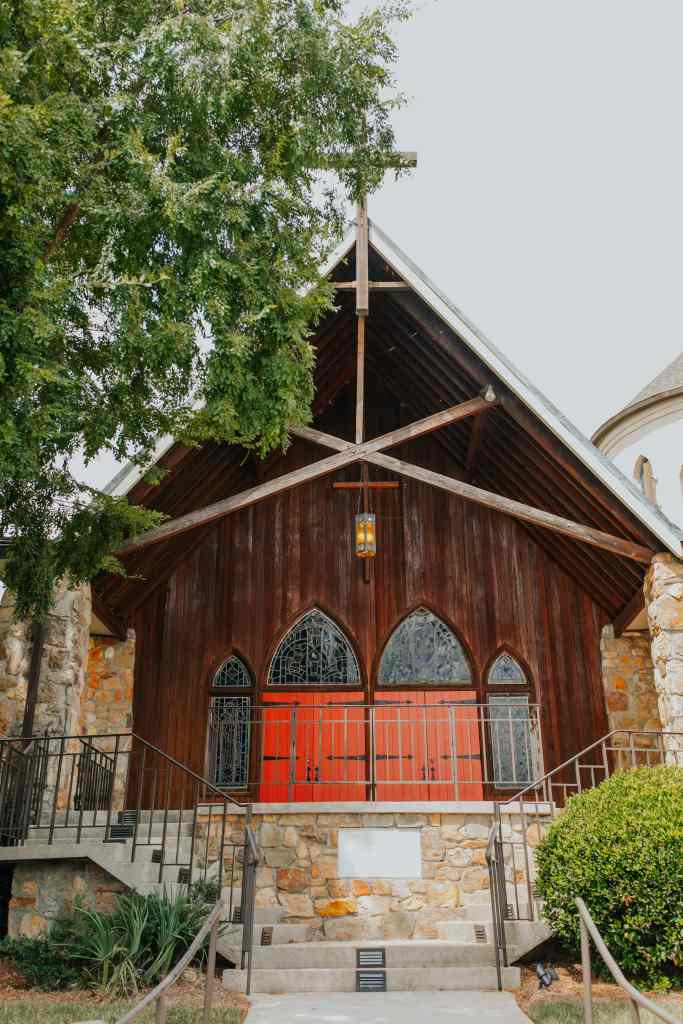
Grace Episcopal Church as it looked during my childhood.
As a denomination, the Episcopal Church has always been more progressive and more involved in social justice issues than other Protestant denominations. Grace Church had a very active youth group that did a lot of work in the area of social justice when I was in high school. That work had a massive influence on my life, both then and later. And by the time I was in high school I was already teaching younger grades in Sunday school and was playing the piano for and traveling with a Black gospel choir, all of whose members went to the Black high school while I attended the all-white high school, as the schools in Gainesville were still segregated.
Playing the piano at the age of 15 and 16 for the gospel choir is a story in itself, as I essentially led a double life. My parents supported the 1960s civil rights movement and were labelled as “communists” by some in my small town. My white friends had no idea my family was as active as it was in the Black community. I managed to hide that part of my life quite well, as it could have been dangerous to let that be known.
At this same time, my parents made the move into more evangelical, Pentecostal Christianity, becoming “saved” and “born again,” even while staying in the Episcopal Church. They took me and my siblings to every Pentecostal church, evangelical meeting, healing service, “miracle” service, and revival meeting that they could find. Both parents became well-known retreat leaders and speakers and were involved on the local, state, national, and even international levels in various evangelical organizations.
I now see how spiritually damaging this was to me and my siblings. We were going to services that were highly emotional. We saw people “get saved,” fall out on the floor, be “delivered” from demons, run up and down the aisles and speak in “tongues,” and we were expected to follow suit.
We continued to attend the Episcopal Church, which although socially progressive, was very staid and formal to the point that Episcopalians were known as “G-d’s frozen people.” I am the eldest and perhaps suffered less than my younger brother and sister, both of whom still struggle with religion to this day.
College and beyond
Once I was away from this and in college, I remained in the Episcopal Church even as I began questioning my Christian beliefs. In fact, I remained an active Episcopalian for decades, always wondering why I could not accept certain core Christian beliefs.
After college, I worked as a newspaper reporter for three years before moving to South Bend, Indiana for graduate school at the Medieval Institute at the University of Notre Dame, studying medieval history, literature and music.
Studying the world of late antiquity, the development of Christianity, how Jesus became “G-d,” the emergence of the Catholic tradition, Catholic theology, and the medieval church, I began to have multiple doubts about the Christian faith. Questioning was not allowed, and one of my professors told me my beliefs were heretical.
However, in medieval music classes, we studied the influence of synagogue chant on early Christian chant, and I was captivated by what I learned there.
While in graduate school I remained in the Episcopal Church. My late husband and I met at the Episcopal cathedral in South Bend and were married there but became members of a smaller parish where our daughter was baptized and confirmed.
I became the church musician for about four years, playing the guitar and leading the singing of all liturgical music and hymns. When an organist was finally hired, he and I continued to sing together. Interestingly, apart from the liturgical music itself, most of the songs were based on the Psalms and writings of the prophets, and we often sang in English what I now know to be the Jewish song of redemption, Mi Chamocha.
Years later, after moving to the North Georgia mountains in rural Appalachia, we immediately joined the local Episcopal church where we were very active. I was a Sunday school teacher and was one of the people who read Scripture from the podium during the service. There were three readings every week. I always chose to be the person who read the “Old Testament” Scripture.

Interestingly, as I made my journey into Judaism, the priest of the parish and my friends there, along with my daughter (who is married to a Christian minister), were my biggest supporters.
 The Appalachian Jew
Leave a comment