
The Road to Conversion
Livestreaming services from Central Synagogue in New York is what made me aware that there was a path by which I could convert to Judaism.
Central Synagogue has a Center for Exploring Judaism, established in 2010 and geared mainly towards those with a Jewish partner or spouse, helping them to understand the Jewish faith and what it means to live a Jewish life. But the program also is open to individuals who desire to explore Judaism. Originally, all classes were held in person at the synagogue, but in recent years online cohorts have been comprised of people literally from around the world.
In late Spring 2023, I contacted Rabbi Lisa Rubin, director of the Center for Exploring Judaism to ask about being accepted into the program. What fascinated me about the hour-long interview with her was that one of the first things she said to me was that she was wondering why a Jewish person (me) would want to be in a cohort group. She considered me to be already living a Jewish life. When I explained that I had been raised as a Christian by parents who also were raised as Christians (even though they knew they were Jewish), she agreed that actual conversion would be the proper course of action for me.
My cohort group consisted of about 40 people from throughout the U.S. and from several other countries. Classes extended over a six-month period from July through December 2023, met once a week on Zoom, and were conducted like university classes. We had a syllabus, several required books, and weekly assignments and were expected to actively participate in class discussions and complete two projects . Both projects could be submitted after classes ended, but no one could be considered an actual candidate for conversion until both were turned in. In addition, each of us had to meet individually on Zoom with Rabbi Rubin on a regular basis.
The following is from Central Synagogue’s website:
Summary of the Conversion Process
1. Initial meeting with Rabbi Lisa Rubin, our Director of the Center for Exploring Judaism
In this introductory meeting, we will discuss your background and interest in Judaism and do our best to ascertain whether our program may be a good fit for you.
2. Enrollment in our Exploring Judaism course
Our course covers the foundations of Judaism: holidays, history, prayer, theology, and life cycle. A new class begins every other month and we meet weekly for a six-month period.
3. One-on-one meetings with Clergy
These regular meetings (during the six-month period of the Exploring Judaism course) are for individual guidance and mentorship.
4. Extended study after the course
Conversion candidates are encouraged to study with a rabbi as long as is needed to attain confidence with a basic “literacy” of Judaism. Time will vary with each student.
5. Completion of a conversion project and spiritual autobiography
Students are asked to complete two small projects toward the end of the conversion process.
6. Bet Din and Mikveh
A bet din (rabbinic court) will be assembled on the day of your conversion followed by a visit to the mikveh (ritual bath).
Everyone in the cohort group had to submit, as one of their projects, a personal spiritual autobiography. Much of my spiritual autobiography has been included in earlier posts of this blog as My Journey Back to Judaism, the Faith of My Ancestors – Part 1, Part 2, and Part 3.
The second project could be anything relating to Judaism that was of interest to the individual student, but the topic had to be approved by Rabbi Rubin. For my second project, I did extensive research, reading another dozen books plus several articles and participating in a webinar sponsored by the Museum of the Southern Jewish Experience in New Orleans. Much of that research also was included in earlier posts of this blog as The Melungeons: Conversos, Crypto-Jews and Hidden Jews in Southern Appalachia – Part 1, Part 2, Part 3, Part 4, Part 5, and in The Melungeons: Conversos, Crypto-Jews and Hidden Jews in Southern Appalachia – Sources.
I submitted my second project in February 2024, thinking I probably was the last person in my cohort to submit their work, but this turned out not to be the case. In addition, I had been under the impression that each of us would be assigned to another rabbi at Central Synagogue to continue studies until such time as that rabbi determined we were ready to complete conversion. That also turned out not to be the case for me.
As soon as Rabbi Rubin had my second assignment in hand she asked me when I could come to New York to complete my conversion.
Conversion
I made the trip to New York in mid-March 2024 and formally converted to Judaism on March 14. Unlike in Christianity, in which conversion is often a public event including baptism witnessed by friends and family, conversion in Judaism is a private event involving only the convert and three rabbis.
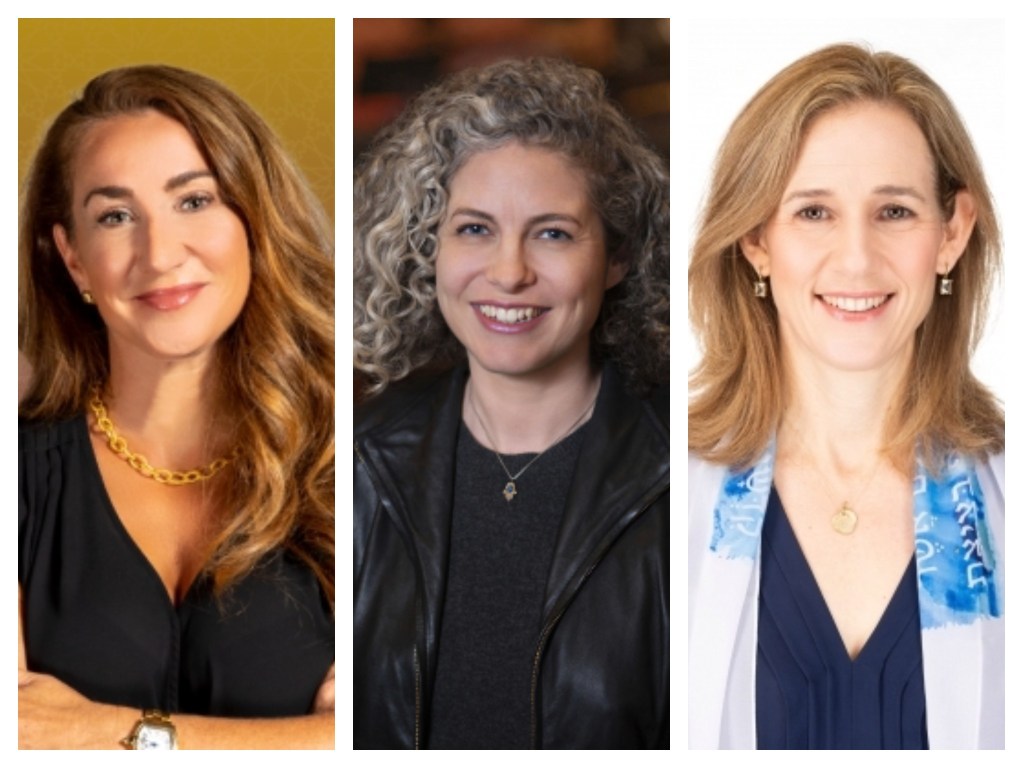
My Bet Din, or rabbinic court, consisted of three female rabbis, all of whom teach in the Center for Exploring Judaism.
(Two other members of my cohort converted on the same day and one had a different configuration of rabbis on her Bet Din.)
I expected an intimidating scene in which I would be grilled by the rabbis on various aspects of Judaism, but it turned out to be a delightful discussion. All three rabbis considered me to be living a Jewish life and told me that they saw me not so much to be converting as returning to the faith my ancestors had once practiced but that had been hidden for several generations.
As part of my conversion I was formally given my Hebrew name, which, as an adult, I had chosen. I kept my given name, given to me at birth by my mother who had named me for a heroine in the Hebrew scriptures, but I changed my middle name from Leigh (Leah) to Shira, a name that means song because I have always been a singer. דבורה שירה
Immersion in the mikveh, the ritual bath, is an integral part of conversion. Central Synagogue uses the community mikveh on the Upper West Side in Manhattan. Those coming to the mikveh enter from the street through a rather non-descript door to find a beautiful, spa-like atmosphere inside. As a convert, I immersed in the mikveh’s warm water alone, completely submerging three times and saying a specific blessing after each immersion. The rabbis waited outside the door and greeted me with a rousing chorus of Siman Tov Mazel Tov.
Here’s what that sounds like…
Afterwards, I was given the priestly benediction and was declared to be officially a part of the Jewish people.
The priestly benediction can be heard here, beginning at about 3:11 in the video. Here, Central Synagogue’s Senior Rabbi Angela Buchdahl gives the blessing to former Supreme Court Justice Stephen Breyer who had been interviewed at the synagogue…
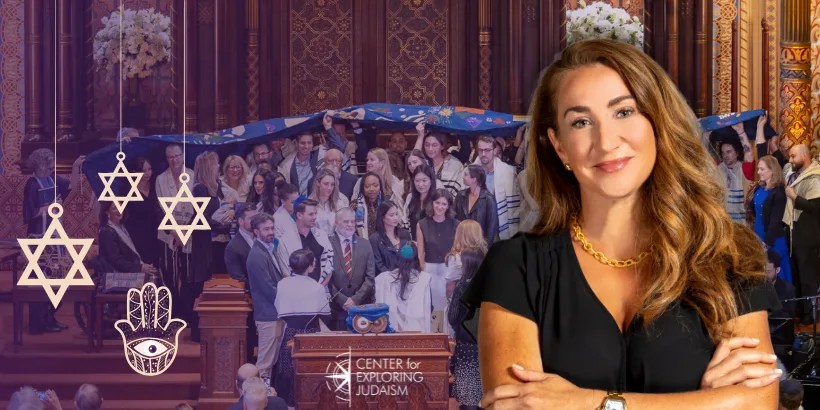
The evening following my conversion was a Friday, and at Central’s Friday night Shabbat service, I along with many others who had converted at Central Synagogue in the preceding twelve months, was called to the bimah (the platform at the front of the synagogue) to bless the reading of the Torah and to receive the priestly benediction.
In this photo, which features Rabbi Rubin from the Center for Exploring Judaism, I am among the group on the bimah although, because I am so short, I cannot be seen.
I returned home from New York a different person, knowing for certain what I had “known” all of my life, that I was, in fact, a Jew. I finally was where I belong.
The following song from Temple Israel Westport expresses what I had always known. Written and sung by Cantor Becky Mann, on the left, joined by Cantor Julia Cadrain (formerly at Central Synagogue) on the right, it says, “You’ve always belonged here.”


 The Appalachian Jew
Leave a comment